
Maxell and Institute of SCIENCE TOKYO Begin Joint Development of Next-Generation Batteries Based on 3D-SLISE Electrolyte Technology
October 28, 2026 - Maxell, Ltd. (President and Representative Director: Keiji Nakamura; hereinafter “Maxell”) has launched a joint development project with researchers led by Specially Appointed Professor Yosuke Shiratori of the Institute of SCIENCE TOKYO (hereinafter “SCIENCE TOKYO”) on next-generation batteries utilizing an Aqueous Composite Quasi-Solid Electrolyte (3D-SLISE*1).
Because this next-generation battery does not use flammable organic electrolytes, it is expected to offer a reduced risk of fire. 3D-SLISE*1 is an electrolyte containing water molecules at the interfaces between ceramic particles. By mixing it with water to form a slime-like electrolyte, batteries can be manufactured using coating-based processes.
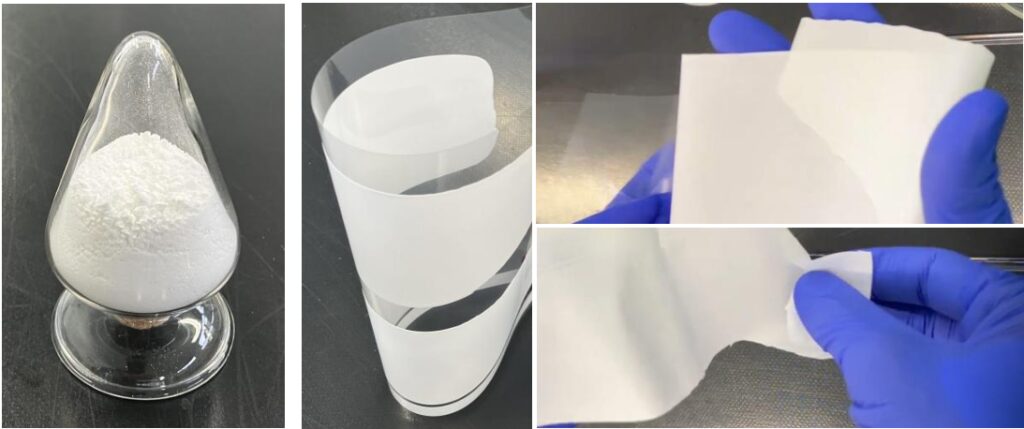
and sheet fabricated by coating and drying 3D-SLISE (right)
This technology enables the use of coating technologies and production equipment that Maxell has cultivated through the manufacturing of lithium-ion battery electrodes. In addition, because neither dry rooms nor organic solvents are required, it is expected to contribute to reducing environmental impact through lower VOC (Volatile Organic Compound) emissions and reduced power consumption during manufacturing processes.
Furthermore, the battery is expected to offer excellent recyclability as 3D-SLISE*1 can be dissolved in water after use, making it easier to recover active materials.
Potential applications include uninterruptible power supply (UPS) systems for data centers, as well as power tools and automated guided vehicles (AGVs), where stringent safety requirements are essential. In particular, while lithium-ion battery-based UPS systems are increasingly being adopted in data centers to improve energy efficiency and reduce installation space, mitigating fire risks associated with thermal runaway and strengthening fire protection measures remain important challenges. Because even a single fire incident can significantly impact facility operations and business continuity, exceptionally high levels of fire safety are required.
Through this joint research project, Maxell and SCIENCE TOKYO aim to leverage 3D-SLISE*1, a water-containing aqueous composite quasi-solid electrolyte, to reduce fire risks and improve the safety of people and equipment. They also seek to contribute to reducing the burden associated with fire protection systems and lowering overall facility operating costs in data centers.
Under its corporate byline, “Micro batteries. Maximum impact.”, Maxell embodies the belief that small batteries can create great value. Moving forward, leveraging four pillars of high reliability, high heat resistance, high power output, and large capacity, Maxell aims to commercialize batteries that can be used in the fields where conventional batteries have not been suitable, and contribute to the resolution of social challenges and the realization of a sustainable society.
*1 3D-SLISE:
Reference News Release: Institute of SCIENCE TOKYO News Release (August 21, 2025) “3D-SLISE: a quasi-solid electrolyte for safer and greener lithium-ion batteries”
https://www.isct.ac.jp/en/news/vhjic7f877cg